
Thoughts on Oneohtrix Point Never's Tranquilizer

Sometimes—because I happen to be both a library and archives nerd and a bit of an electronic music nerd—I like to think about how the trajectory of contemporary electronic music might’ve been altered if Daniel Lopatin (aka Oneohtrix Point Never) hadn’t dropped out of Pratt (where he was studying archival science) and, instead, just … graduated and become a data archivist. I’m sure he would’ve been fine at it, serving some institution or foundation admirably, but, as a trade-off, we would’ve been deprived of some of the most moving and groundbreaking electronic music of the twenty-first century.
My friend Andrew and I were reminiscing about Lopatin’s discography this past week, inspired by the release of his beautiful new eleventh record, Tranquilizer. We were discussing how we were the perfect age to receive his work when he came to prominence—I was 20-years-old when 2010’s Returnal came out—and I’ve been able to map significant changes in my life to new entries in Lopatin’s discography. 2011’s plunderphonic masterpiece, Replica, arrived when I was on the Katimavik youth volunteer program, and I remember my first listen to the record—having been sent a link to it by Andrew—was in the backseat of our group’s passenger van on an eerie late night drive through some rural Quebec valleys. 2015’s “hypergrunge” Garden of Delete came out when Andrew and I were briefly living together in an old heritage apartment in downtown Regina, SK, and I remember us frenetically discussing the record and its jarring aesthetic choices in our kitchen. By 2018, I was living in Montreal and gearing up for my MA graduation in the early summer when Lopatin released Age Of, and I remember first listening to it in McGill Library’s Birks Reading Room on my headphones using a VPN to access it on Spotify early by changing my geolocation to Tokyo. 2020 saw Lopatin release Magic Oneohtrix Point Never, a gorgeous meditation on radio formats—specifically, the moment when radio stations change formats, so-called “format flips”—that perfectly suited the late-2020 moment of pandemic-induced solipsism and mania. I could go on like this, probably tediously so for the readers that are still with me.
I think another reason that Lopatin’s work has always been so fascinating to me is the aforementioned fact that he studied archival science before dropping out to fully commit to his music career, and that he also has a keen interest in philosophy nurtured at Hampshire College under the mentorship of Christoph Cox. Each OPN album usually arrives with Lopatin talking openly and hyper-articulately about various philosophical or conceptual “framing devices” for the work.1 2013’s r+7, for example, was influenced—according to Lopatin—by his exploration of object oriented ontology and Timothy Morton’s work. Garden of Delete engaged Kristeva and the abject in relation to the deep awkwardness of male puberty. Age Of was, in part, influenced by Strauss-Howe generational theory.
Tranquilizer arrives with fewer philosophical concepts overtly framing it, but it is a process-based work, similar to Lopatin’s approach to making Replica. For Replica, according to album’s lore, he purchased a DVD of old ‘80s and ‘90s TV commercials and jingles online, and sampled elements of this cultural detritus until it was defamiliarized beyond recognition, and hauntologically reanimated. One of my favourite videos on YouTube is where someone somehow painstakingly excavated many of Replica’s samples:
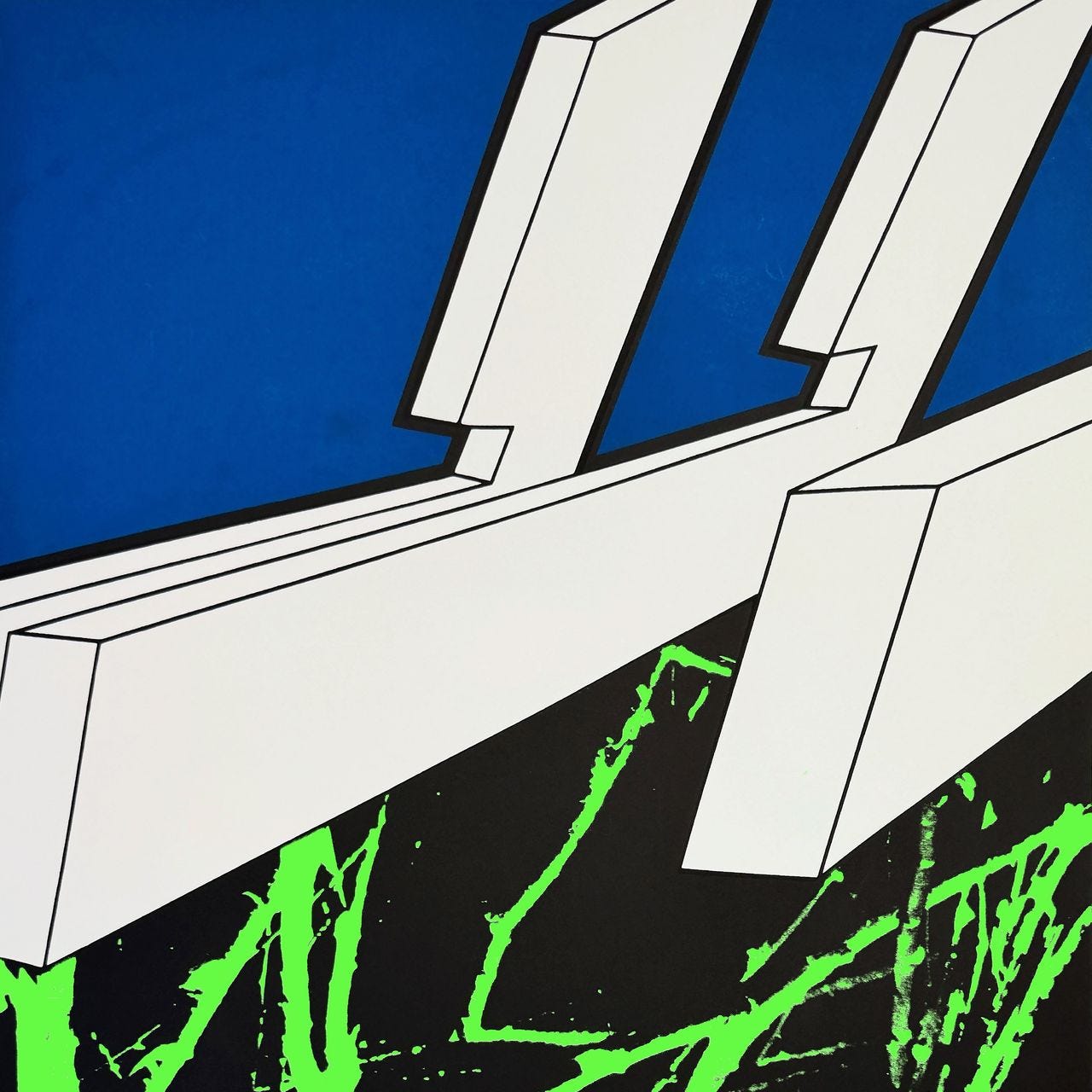
Tranquilizer—according to the album’s press copy and a new, extensive interview that Lopatin gave to Joshua Minsoo Kim at the indispensable Tone Glow newsletter—is built out of an archive of ‘90s sample CDs and so-called “romplers” stored on the Internet Archive that the artist discovered a few years ago and bookmarked to possibly use in a later project. When Lopatin went back to check for the collection, however, it had disappeared, and he went to work on 2023’s Again. Later on, though, Lopatin checked again and the collection had miraculously resurfaced, which motivated him to work on the album, inspired now, in part, by the ephemerality of the online archive itself.
Given that the circumstances of its creation were very much in flux, Tranquilizer is an achingly gorgeous album that feels like a sibling record to Replica, to me. It is also tremendously difficult to pin down—its tones and textures are always shifting, never exactly allowing the music to drift into the background as functional, utilitarian cafe-core, “ambient” music to send some emails to. I have been trying to write this post about it for almost a week, and—for the better part of that week—I had a single character typed out (“T”) at the beginning of this post. Each time I tried to articulate my thoughts or feelings about the record, I would throw it on to listen to it just one more time, and then I would be completely consumed by it again.
So, instead of presenting some type of Grand Overarching Theory of Tranquilizer here, I’ll think I’ll just highlight some of the moments on the record that I have found to be the most affecting:
“Measuring Ruins”: I have played this track probably over 20 times in the last week, feeling transfixed by how gorgeous its melody is. It kind of reminds me of “Ouroboros” off of Returnal because it is a moment when Lopatin is allowing himself to be uncomplicatedly gorgeous in melodic terms and through the track’s sound design. What a tremendously evocative title, too!
“Fear of Symmetry”: I am such a sucker for whenever Lopatin uses pianos! The obvious comparison points here are to the title track and “Power of Persuasion” on Replica.
“Rodl Glide”: lots of folks appear to be losing their minds to this one online since the record leaked last weekend. It is a ridiculously good track that—in its own way—appears to be engaging with Lopatin’s practice of eccojamming perhaps. I won’t spoil things, but this one really … goes some places!
“Waterfalls”: the best way to describe this track is to simply cede the floor to Marko Djurdjić’s on-point prose in his Exclaim review of Tranquilizer2:
Unsurprisingly, “Waterfalls” bubbles and bops along gracefully as rainsticks conjure up images of minerals, gems, and the listening booths at Bowring and The Nature Company — ah, the commercialization of alternative spirituality; what a time to be alive and obsessed with malls. It’s very Cirque du Soleilian, and while this ups the cheese factor, it’s also refreshing, affective, sincere; a knowing wink to the unpretentious and — oh my OshKosh B’gosh, was that a synth-sax?! At times dissonant, at others, transcendent, “Waterfalls” is a harpsichord-infused eucalyptus bath, its sandalwood samples, fretless bass and marimba merging into a pitch-bent mini-masterpiece.
There’s my Tranquilizer taster pack for you. It has honestly been so moving to experience this record over the past week, and to think along with it, as I try to do with all of Lopatin’s best work. He is a singular composer, and, in a broader sense, I actually think that he has continued to work in archival science through his music. Tranquilizer—like Replica before it—preserves so-called “forgotten” or “lost” media by alchemizing that media through Lopatin’s distinct artistic sensibility. It’s a sensibility that remains one of the most unique and vital in contemporary music, and Tranquilizer evinces it repeatedly across its engrossing, close-to-hour-long runtime.
Some folks have—perhaps deservedly at times—clowned on this tendency of Lopatin’s, but I always love reading him talking about his work. He is, to my mind, one of the most articulate musicians working today. See, for example, this wonderful essay that he wrote in 2015 for The Talkhouse—remember that website?—about taste and Kenny G’s Brazilian Nights album, and also the more recent chapter in Liam Inscoe-Jones’ Songs in the Key of MP3 that Lopatin did an interview for.
And also to tip one’s cap to his use of “Cirque du Soleilian” lol